Español
  Deutsch
  Français
  Nederlands

The Never-Ending Debate at the Dog Park
If you talk to dog owners, you’ll quickly hear strong opinions about dog food. Fresh meat is said to be the most natural option. Dry kibble, on the other hand, is considered safer and more nutritionally complete. Wet food is sometimes seen as a treat, even though for some dogs it can actually be a very good daily choice.
The truth is more nuanced. A dog can thrive on a fresh meat diet, but only if the composition is right and hygiene is taken seriously. A dog can also age healthily on dog kibble, provided that the kibble is made from high-quality ingredients and does not consist primarily of fillers.
So it’s not just about the form. It’s about what’s inside, how well your dog digests it, and how practical it is in everyday life.
The Hard Truth About Fresh Meat for Dogs
Fresh meat for dogs, often referred to as KVV, has a strong appeal. It looks pure, smells intense, and seems like exactly what a dog naturally loves to eat. Many owners notice that their dogs react enthusiastically to it. Still, this type of diet deserves an objective look, taking both the pros and cons into account.
The benefits for the intestines and coat
When fresh meat is properly formulated, it can offer many benefits. It often contains a high proportion of animal-based ingredients and few unnecessary additives. As a result, it is easily digestible for many dogs.
Owners sometimes notice that their dog’s stool becomes firmer, its coat becomes shinier, and the dog eats with more enthusiasm. That’s not surprising. A diet with recognizable ingredients and a high meat content is well-suited to what many dogs digest easily. Especially for dogs that are sensitive to complex recipes, simplicity can provide a lot of peace of mind.
The Risk of Bacteria, the Freezer, and Clumsiness
Still, fresh meat isn’t the ideal solution for every household. It has to be stored in the freezer, takes up space, and needs to be thawed in advance. If you forget to set it out, you’ll immediately face a practical problem around dinnertime. It’s also often less convenient when you’re on the go or on vacation.
In addition, raw meat requires careful hygiene. It may contain bacteria, such as salmonella. For healthy adult dogs, this isn’t necessarily a problem right away, but in a household with young children, the elderly, or people with weakened immune systems, you’ll want to be extra careful. Dogs don’t just eat from their bowls—they also lick hands, faces, toys, and furniture afterward.
That’s why it’s important to look beyond the romanticized image of pure meat. Fresh meat can be appealing, but it requires discipline and isn’t suitable for every household.

So are traditional kibbles better?
Dog food is popular because it’s convenient. You just open the bag, measure out the portion, and you’re done. Plus, dog food has a long shelf life, is easy to take with you, and is simple to portion out. That makes it appealing to many pet owners.
But here, too, the difference lies in the quality. Not every kibble is automatically complete, pure, or easily digestible. Attractive packaging says little about what actually ends up in the food bowl.
Watch out for well-known dog food brands
Many well-known dog food brands use ingredients that are primarily cost-effective to produce. These include large amounts of grains, cheap fillers, and vague terms like “animal by-products.” For a dog with a strong stomach, this doesn’t always cause immediate problems, but for sensitive dogs, it can lead to itching, gas, irregular stools, or a dull coat.
The problem is that, as a pet owner, you often can’t tell exactly which animal proteins have been used. Chicken, beef, pork, or other sources may be mixed together. If your dog has a sensitive reaction to something, it becomes nearly impossible to figure out what’s causing it.
That’s why it’s wise to look not only at kibble or meat, but especially at transparency. A good food clearly states which protein source is used and why.
The happy medium known as fresh kibble
Fortunately, you don’t have to choose between freezer drawers full of raw meat and some random kibble off the supermarket shelf. There’s a middle ground that’s appealing to more and more dog owners: food that’s rich in animal-based ingredients, easy to digest, and still practical to use.
That’s exactly where high-quality wet food and pure single-protein kibble come into play. They combine the benefits of simplicity and taste with the convenience you need in your daily life.
Why Hypoallergenic Wet Food Makes Both Dogs and Their Owners Happy
For many dogs, high-quality wet food is a great option. It has a high moisture content, a strong aroma, and a soft texture. As a result, it’s often appealing to picky eaters, senior dogs, and dogs that could use a little extra help with their fluid intake.
High-quality wet food comes close to the concept of fresh meat, but without the hassle of thawing, storing in the freezer, and handling raw ingredients. It’s hygienically packaged, easy to portion out, and convenient to take with you.
For sensitive dogs, the ingredients are especially important. If you choose wet food with a single, clearly identified source of animal protein, your dog’s diet will remain straightforward. This helps ease the digestive system and makes it easier to figure out what your dog responds well to.
Pure meat in a crispy coating
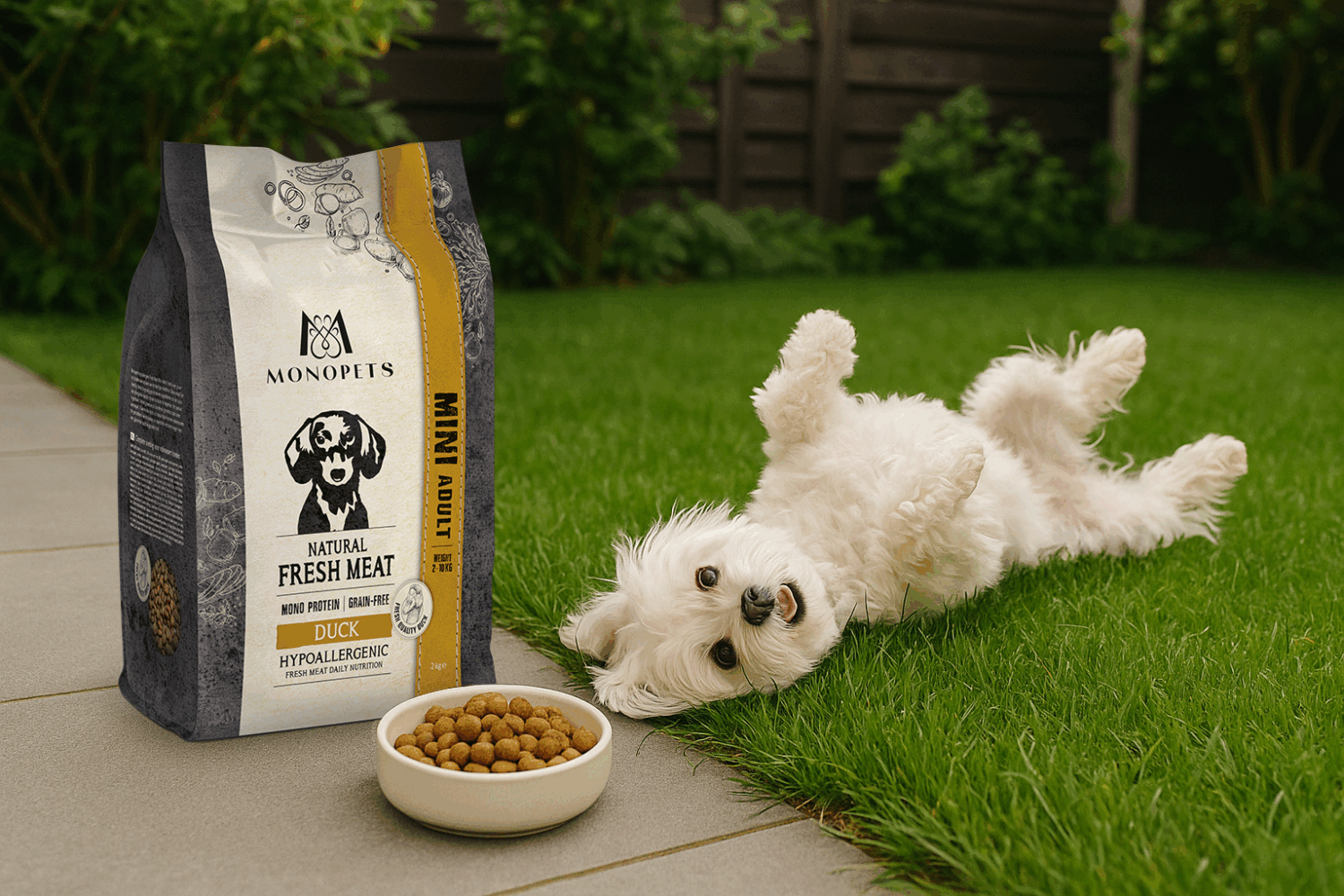
For pet owners who prefer to feed kibble, hypoallergenic kibble is a smart choice. You get the convenience of dry food, but you’re choosing a formula that’s much simpler than standard kibble with multiple protein sources.
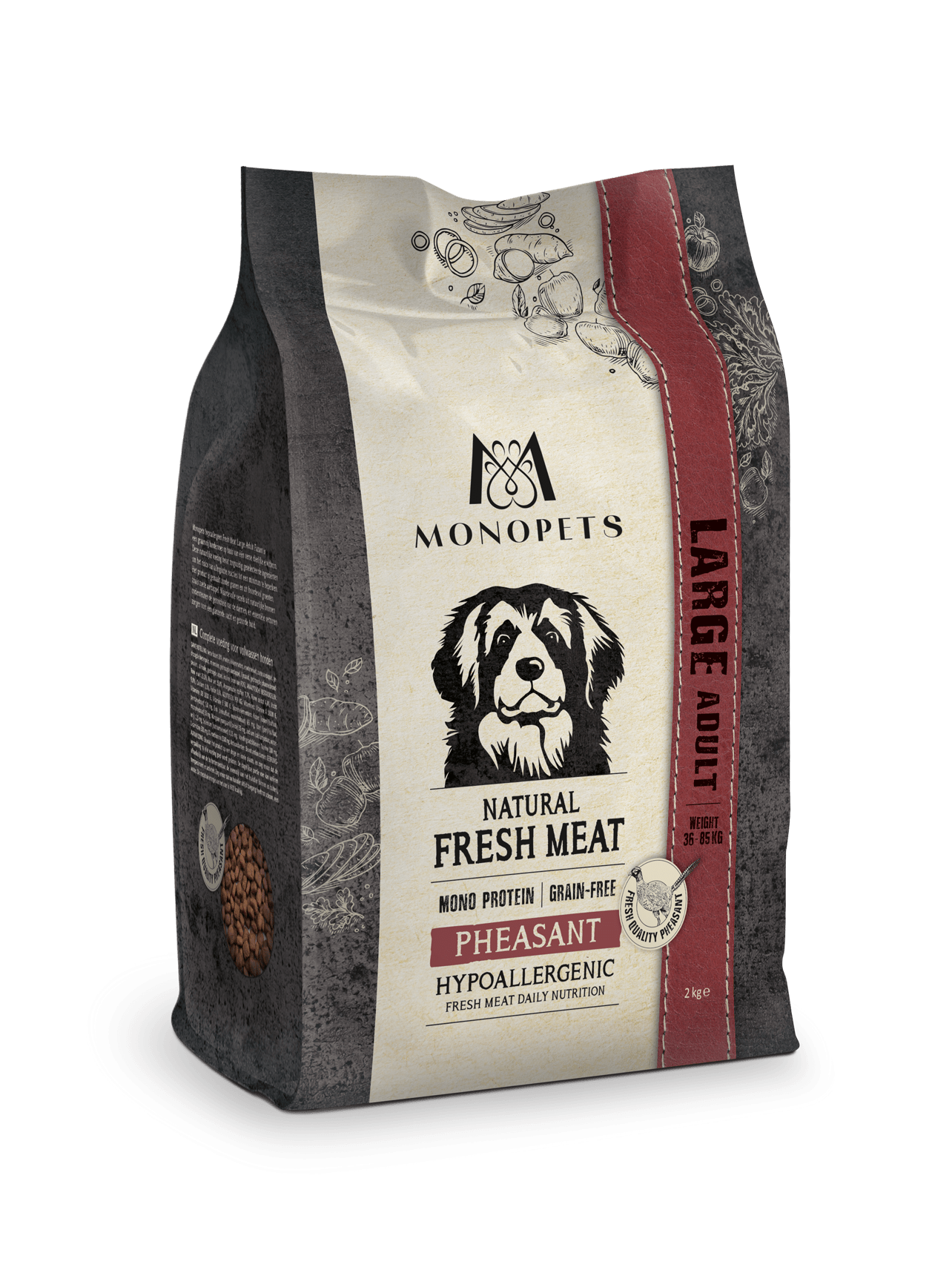
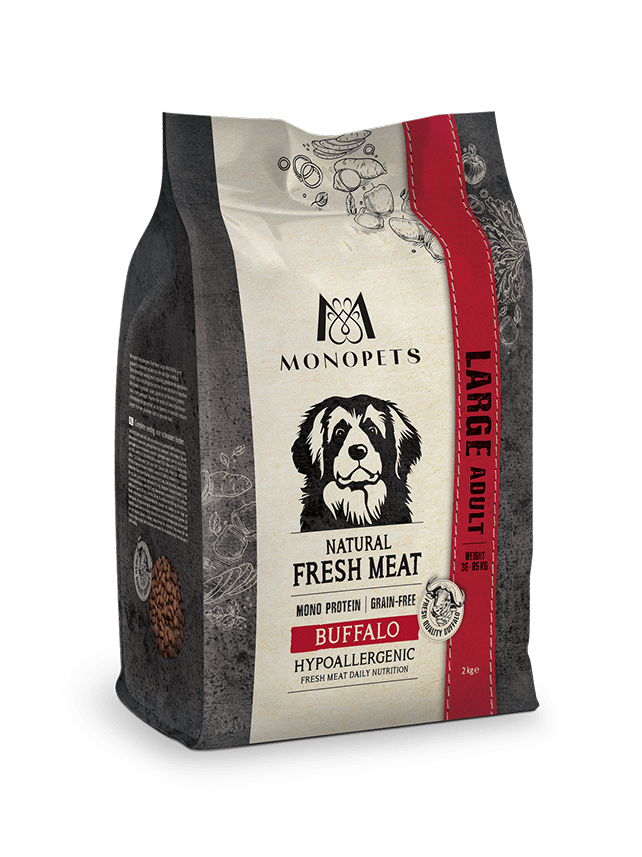
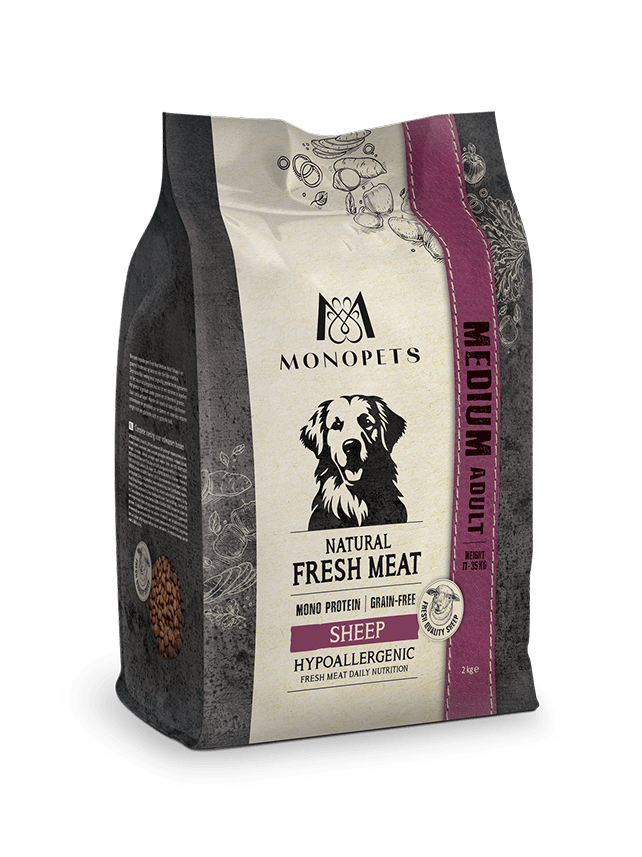
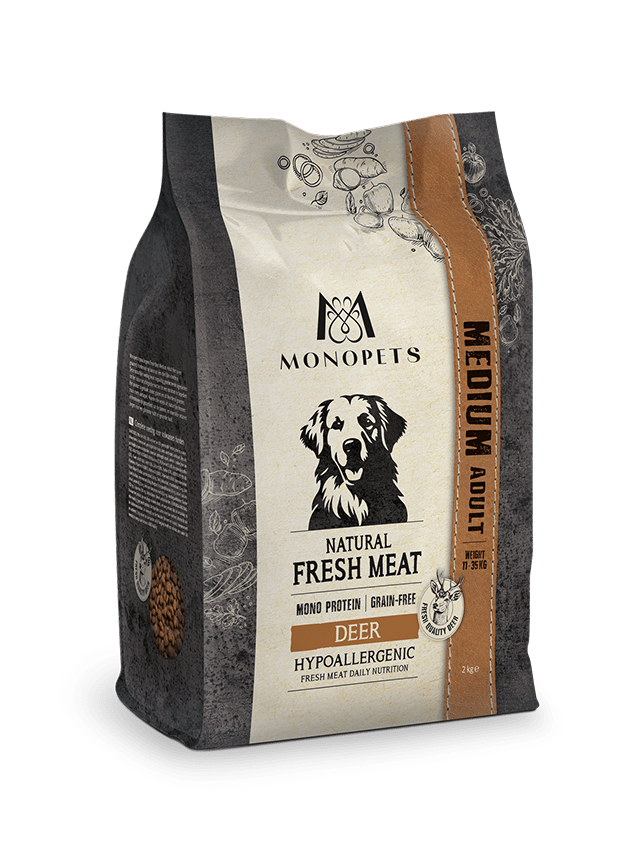
At Monopets, we focus on clear, simple nutrition with a single source of animal protein per variety. This makes it easier for you to keep track of your dog’s diet and often helps your dog digest the food more easily. Especially if your dog is sensitive to certain ingredients, this simple formula provides a lot of peace of mind.
This can also be a convenient transition for dogs switching from fresh meat to kibble. The food remains rich in animal-based ingredients and meets the need for simplicity, while making feeding much more practical.
What’s the best fit for your dog?
The best choice isn’t necessarily fresh meat, wet food, or kibble. The best choice is food that suits your dog, your household, and any sensitivities you may have already noticed. If your dog is prone to stomach upset, itching, or inconsistent stools, simplicity is often the first step. Choose a clear source of protein, avoid unnecessary additives, and introduce new foods gradually.
Monopets helps you make that choice easier. Whether you opt for rich wet food or convenient single-protein kibble, you’re choosing food that prioritizes quality, digestibility, and transparency. This way, you give your dog the benefits of a pure diet without any unnecessary hassle at home.
 Veterinary diet

 Medium dog (11 - 32 kg)
 Large dog (> 33 kg)


 Small dog (2 - 10 kg)
  Daily food